Walk through the art world now and two very different futures seem to be unfolding at the same time.
In one gallery, an artist may be working with clay, woven fibers, wood, glass or techniques that have existed for generations. Across town, another exhibition may be built from algorithms, enormous digital projections and artificial intelligence.
Neither direction appears to be replacing the other.
Instead, contemporary art is increasingly being shaped by the tension between them.
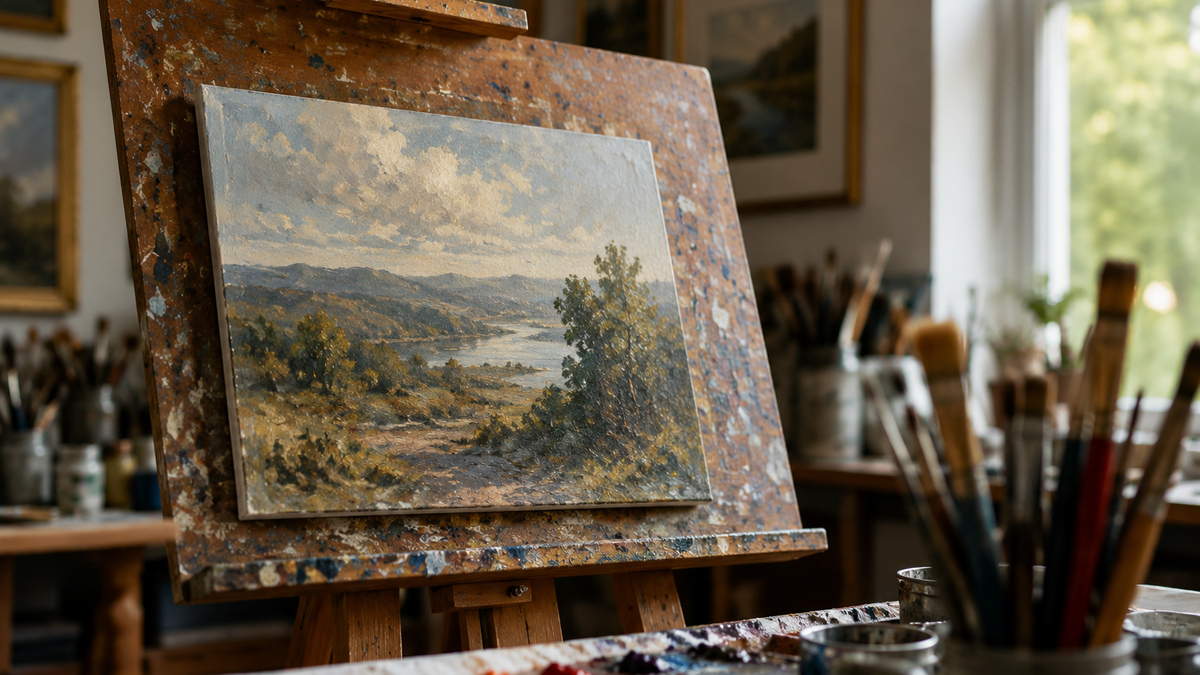
As technology becomes capable of producing images almost instantly, artists, museums and collectors are also paying renewed attention to the physical qualities that technology cannot easily reproduce: texture, evidence of the hand, traditional craftsmanship, imperfect materials and objects that clearly took time to make.
Technology Is Moving Into the Museum
The technological side of the art world is difficult to miss.
In June 2026, DATALAND opened in Los Angeles as what its founders describe as the world’s first museum dedicated to AI arts. Its inaugural exhibition uses artificial intelligence, enormous digital displays, sound, scent and even visitor biometric information to create environments that change as people experience them.
Elsewhere, museums are increasingly exhibiting art made with algorithms and generative systems.
The Blanton Museum of Art in Austin, for example, presented Run the Code in 2026, an exhibition featuring artists using algorithms and generative AI to explore subjects ranging from nature and art history to internet culture and human behavior.
These works represent a dramatic expansion of what the word “art” can describe.
A painting once existed primarily on canvas.
A sculpture occupied physical space.
Now an artwork might exist as software, respond to the person standing in front of it or continually produce new visual forms.
At the Same Time, the Handmade Is Becoming More Visible
The rise of technological art has not caused traditional materials to disappear.
In some corners of the art world, it appears to be making them more noticeable.
Contemporary artists are working with ceramics, textiles, metals, glass, woodworking and other practices that historically sat somewhere between fine art and craft. A new generation of American makers is also reinterpreting those techniques rather than simply preserving them exactly as they existed in the past.
That distinction matters.
The current interest in craft is not necessarily nostalgia.
An artist can use a centuries-old process while producing work that speaks directly to contemporary life.
Traditional materials can address identity, technology, environmental questions, cultural memory and modern politics just as easily as paint or digital media can.
Imperfection Has Acquired New Meaning
For much of modern consumer culture, technological progress has meant making things smoother, faster and more consistent.
Digital tools can remove imperfections from photographs. Software can straighten lines, correct colors and reproduce an image indefinitely. Generative systems can create polished visual material in seconds.
Against that background, imperfections created by hand can become unusually visible.
A fingerprint left in clay, an irregular line in a drawing or variations in woven material tell the viewer something about how an object came into existence.
Those characteristics were once things that manufacturing often tried to eliminate.
Now they can function almost like evidence.
They show that someone physically made the object.
That does not automatically make handmade work better than digital art, but it does change how people may perceive it in an environment increasingly filled with machine-generated images.
Old Techniques Are Being Used for New Ideas
Looking backward in art rarely means simply recreating the past.
Artists regularly return to older forms precisely because those forms can be reinterpreted.
Traditional textile techniques might be used to explore migration or family history.
Ceramics can become large-scale sculpture rather than household pottery.
Glass can move beyond decorative objects and become conceptual or architectural work.
Contemporary studio glass itself illustrates how a material associated with traditional craftsmanship can evolve into a major artistic medium through experimentation, collaboration and new production methods.
The result is an art world where the distinction between “old” and “new” becomes increasingly difficult to maintain.
The material may be ancient.
The idea may be entirely contemporary.
Artists Are Mixing the Two Worlds
Some of the most interesting work does not choose between technology and tradition at all.
Artists can sketch by hand and finish digitally.
They can scan physical materials into a computer, create three-dimensional models and then return those designs to the physical world through fabrication.
Digital artists are increasingly moving between 2D illustration, 3D environments, animation, game engines and traditional media rather than staying within a single format.
That movement makes the idea of a purely “digital artist” or purely “traditional artist” less useful than it once was.
The tools are becoming part of a larger creative vocabulary.
A computer may be one tool among many, no more definitive of the artist than a camera, kiln or paintbrush.
AI Has Made the Question More Complicated
Artificial intelligence has intensified this discussion because it changes one of the oldest assumptions about art: that creating an image requires the artist to physically construct that image.
Generative AI challenges that relationship.
It can produce sophisticated imagery from written instructions, which has led artists, galleries and collectors to debate questions about authorship, originality and how much human involvement is necessary for something to be considered an artwork.
The market itself remains cautious. In a 2026 Artsy survey, 41 percent of galleries said AI rarely came up in conversations with collectors, while 16 percent reported that collectors actively avoided works created with AI assistance.
So while AI has become impossible for the art world to ignore, that does not mean audiences have uniformly embraced AI-generated art.
Museums Are Becoming Places Where These Questions Play Out
Museums have always preserved the past while presenting the present.
Technology is making that role more complicated.
A museum today may simultaneously conserve a fragile handmade object created centuries ago and display an installation powered by software that did not exist a few years earlier.
That contrast can be striking.
It also reflects something larger happening in culture.
Technological advancement does not necessarily erase older forms.
Sometimes it makes people look at them differently.
Photography did not eliminate painting.
Recorded music did not eliminate live performance.
Digital books did not eliminate printed ones.
New technologies tend to change the meaning and role of what came before them.
Art appears to be going through another version of that process now.
The Future of Art May Not Look Particularly Futuristic
It would be easy to assume that the art of the future will become increasingly digital.
Some of it certainly will.
There will be AI systems, immersive environments, virtual spaces and artistic tools that do not yet exist.
But there will also be clay.
There will be paint, wood, fabric, metal, glass and people making objects slowly with their hands.
The surprising part of contemporary art is that these directions can grow at the same time.
Technology is expanding what artists can do.
It is also making some of the oldest ways of making art newly noticeable.
That may be why the art world seems to be looking backward just as technology accelerates forward.
The past and the future are no longer sitting at opposite ends of the gallery.
Increasingly, they are hanging next to each other.