For generations, education was often built around one central assumption: students needed to learn information because access to information was limited.
That world has changed.
Today, facts, explanations, opinions, statistics, videos and entire libraries can be reached within seconds. Artificial intelligence can summarize complex subjects, answer questions and produce polished writing almost instantly.
The challenge is no longer simply finding information.
It is deciding what to trust, what to question and what to do with it.
That makes the ability to think clearly one of the most important skills education can develop.
Knowing Something Is Not the Same as Understanding It
Memorization still has value.
Students need vocabulary, historical knowledge, mathematical rules and basic facts in order to understand more complicated ideas.
But remembering information and understanding information are different things.
A student may know a formula without understanding when to use it.
Someone may remember a historical date without understanding why the event mattered.
A person may repeat a scientific claim without knowing how the evidence behind it was produced.
Real understanding begins when students can explain an idea, question it, compare it with other information and apply it in a new situation.
Information Is Easier to Find Than Ever
The internet has changed the purpose of education.
A student no longer needs to remember every detail simply because there may be no other way to retrieve it later.
What matters increasingly is knowing how to locate reliable information and evaluate it.
That sounds simple, but it is not.
Search results can contain accurate reporting beside advertising, opinion, outdated information and misinformation.
Social media can place expert analysis next to confident claims from people with no relevant knowledge.
Artificial intelligence can produce an answer that sounds authoritative even when parts of it are wrong.
Access to more information therefore creates a new problem.
People must become better at judging information, not merely consuming it.
Good Thinking Requires Asking Better Questions
One of the clearest differences between passive learning and active thinking is the quality of the questions being asked.
Why do we believe this?
What evidence supports it?
What evidence would change the conclusion?
Who produced the information?
What might be missing?
Are two things actually connected, or do they simply appear together?
Could there be another explanation?
Questions like these are useful far beyond school.
They matter when reading the news, comparing financial decisions, evaluating health claims, choosing a product, deciding how to vote or interpreting something seen online.
The ability to ask a good question can sometimes be more valuable than immediately knowing the answer.
Critical Thinking Is Not the Same as Being Skeptical of Everything
Thinking critically does not mean automatically assuming that every claim is false.
It means evaluating claims in proportion to the evidence behind them.
Some sources are more reliable than others.
Some questions have strong scientific consensus.
Others remain uncertain.
Some arguments are supported by extensive evidence, while others rely mainly on personal experience or speculation.
A strong thinker learns to distinguish between those categories.
That requires judgment.
And judgment develops through practice.
Students Need to Know How Evidence Works
One of the most useful skills education can provide is an understanding of how evidence is created.
A survey can sound impressive until someone asks who was surveyed and how the questions were written.
A statistic can appear dramatic until it is placed in context.
A scientific study may show a relationship without proving that one thing caused another.
A graph can be accurate while still being designed in a way that exaggerates a difference.
These are not merely academic concerns.
Adults encounter similar claims every day in advertisements, political arguments, news reports and social media posts.
The ability to interpret evidence protects people from drawing conclusions that the evidence does not actually support.
Being Wrong Is Part of Thinking Well
Education often rewards correct answers.
That makes sense, but it can unintentionally teach students that being wrong is something to avoid rather than something to examine.
Good thinking requires the opposite attitude.
People need to be able to change their minds when better evidence appears.
They need to recognize when an assumption was incorrect.
They need to separate defending an idea from defending their identity.
That can be difficult.
But intellectual flexibility is one of the most important parts of learning.
A person who never revises an opinion is not necessarily confident.
They may simply have stopped evaluating it.
Problem-Solving Matters Because Real Life Is Messy
Many school problems are designed to have one correct answer.
Real-world problems usually are not.
A community deciding how to reduce traffic must balance cost, convenience, environmental impact and public opinion.
A business deciding whether to expand must weigh demand, risk, staffing and financing.
A family making a major financial decision may need to consider several options, none of which is perfect.
These situations require more than remembering information.
They require comparing tradeoffs.
Students who practice solving open-ended problems learn that good decisions often involve uncertainty.
Creativity and Critical Thinking Work Together
Thinking well is not only about analyzing information.
It is also about imagining alternatives.
A strong problem-solver needs to be able to ask, “What else could work?”
That is where creativity becomes part of critical thinking.
Creative thinking generates possibilities.
Critical thinking evaluates them.
The two skills work together.
Without creativity, people may never consider a better solution.
Without critical thinking, they may never recognize which ideas are practical.
Technology Makes Human Judgment More Important
As digital tools become more powerful, some people assume that human knowledge will become less important.
The opposite may be true.
The easier it becomes to generate information, the more important it becomes to evaluate that information.
AI can suggest an answer.
It cannot remove the need to decide whether that answer is appropriate, accurate or useful.
A calculator can perform arithmetic.
It cannot determine whether the calculation being requested makes sense.
A search engine can find thousands of sources.
It cannot guarantee that the person reading them understands their quality.
Technology can extend human capability.
It does not eliminate the need for judgment.
Good Thinking Requires Knowledge Too
There is an important balance.
Critical thinking cannot happen in an intellectual vacuum.
People need background knowledge in order to evaluate new information.
It is difficult to judge a historical argument without knowing history.
It is difficult to evaluate a scientific claim without understanding basic science.
It is difficult to recognize a misleading statistic without knowing something about mathematics.
That means education still needs to teach knowledge.
The goal is to connect that knowledge with reasoning rather than treating memorization as the final destination.
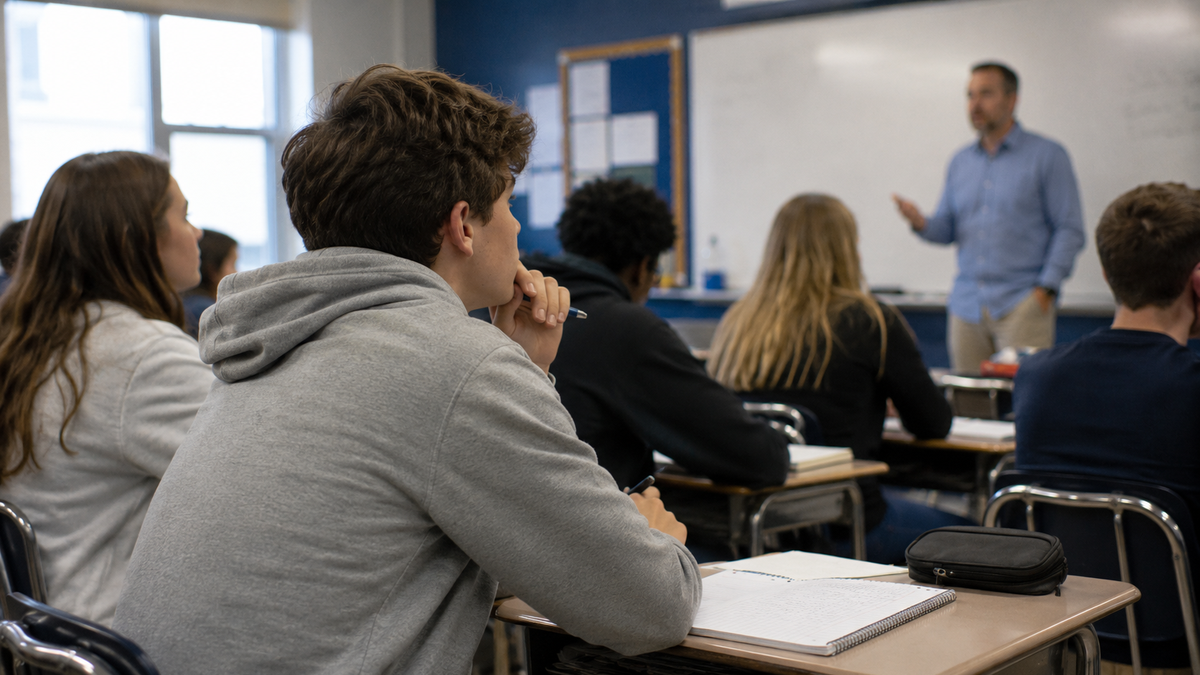
The Classroom Is One of the Best Places to Practice
Schools have a unique opportunity because students can practice thinking before the consequences become serious.
They can debate an idea.
Compare competing explanations.
Analyze a source.
Defend a position.
Change their minds.
Solve a problem with several possible answers.
Explain why they reached a conclusion.
These exercises teach more than the subject being studied.
They teach students how to approach uncertainty.
The Goal Is Not to Tell Students What to Think
Education becomes most valuable when it gives students the tools to reach sound conclusions themselves.
That requires knowledge, evidence, reasoning, curiosity and the willingness to revise an opinion.
Those abilities matter regardless of a person’s career.
They matter to engineers, nurses, teachers, business owners, mechanics, parents, voters and consumers.
The world will continue producing more information.
Technology will continue making that information faster and easier to access.
The people best prepared for that world will not necessarily be the ones who can remember the most facts.
They will be the ones who know what to do with them.