
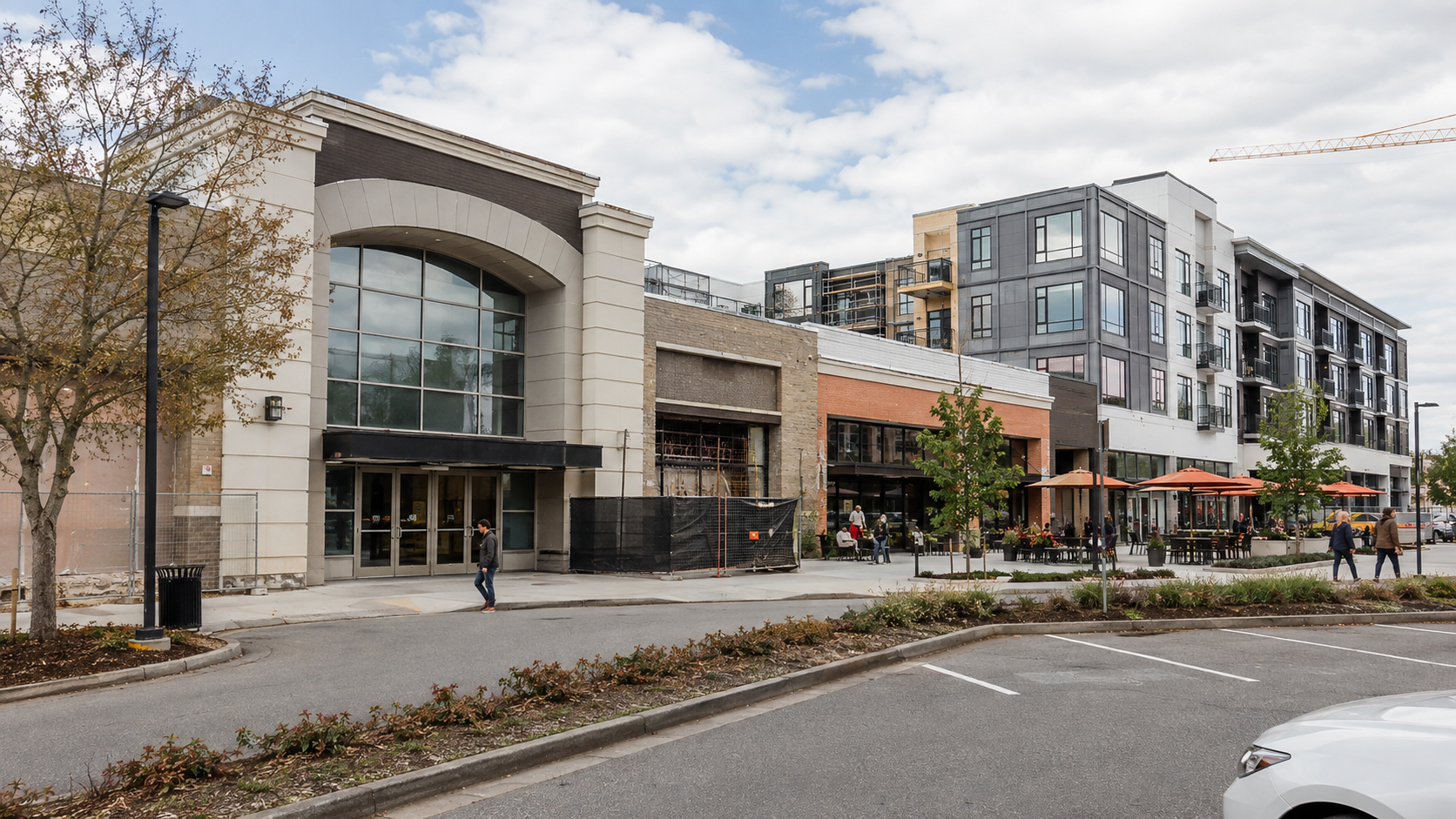
For decades, the mall was one of the defining institutions of American consumer life. Now, across the country, many of those same properties are being remade into apartments, offices, medical centers, colleges, warehouses and mixed-use neighborhoods. The change is not random. It reflects a major shift in how Americans shop, gather and use land.
There was a time when the American mall was more than a place to buy things.
It was where teenagers spent Saturdays, families went during the holidays, and entire suburbs organized their commercial life. Department stores acted as anchors. Smaller chains filled the interior corridors. Food courts turned shopping into a day-long activity. In many communities, the mall was not simply one retail option among many. It was the center of gravity.
That model no longer holds the same power it once did.
While some high-performing malls remain strong, many others have struggled for years with falling traffic, vacant anchor spaces, declining tenant quality and the growing cost of maintaining very large buildings designed for a different era of retail. In response, developers, cities, lenders and property owners have begun treating many of these sites less as malls to be rescued and more as land to be reimagined.
That is why so many American malls are being turned into something else.
The Original Mall Formula Started Breaking Down
The classic mall relied on a retail structure that worked particularly well in the late 20th century.
It assumed that:
-
department stores would remain strong
-
national chain stores would continue expanding
-
suburban shoppers would keep visiting large indoor centers
-
consumer spending would keep supporting a broad middle tier of apparel and specialty retail
-
the mall itself would remain one of the most efficient ways to assemble many stores in one place
Over time, that model weakened from several directions at once.
Department stores lost influence. Big-box retailers changed shopping habits. E-commerce took an increasing share of certain categories, especially apparel, electronics and routine purchases. Consumers also grew more comfortable shopping through their phones for items they once would have visited a mall to compare in person.
The result was not the same everywhere. Some top-tier malls adapted well and continued drawing affluent shoppers. But many mid-tier and lower-tier malls lost the tenant mix and foot traffic that had once made the whole structure work.
A mall does not have to become completely empty to become financially unstable. Once anchor stores close and vacancies become visible, the perception of decline can accelerate the decline itself.
A Mall Is Also a Real Estate Asset, Not Just a Retail Property
One of the easiest mistakes people make when looking at a struggling mall is assuming the question is only, “How do we save the shopping center?”
Developers and owners often ask a different question:
What is the highest and best use of this land now?
That is a real estate question, not a nostalgic one.
Many malls sit on large parcels in highly strategic locations:
-
near highways
-
close to established neighborhoods
-
served by utilities and road infrastructure
-
surrounded by parking
-
positioned in growing suburban corridors
-
already familiar to the public
In other words, even if the retail model is weakening, the site itself may still be extremely valuable.
A large mall property can offer something hard to find elsewhere: a big, already-developed tract of land in an area where people already live, work and drive.
That makes redevelopment attractive.
Why Apartments Are Replacing Department Stores
Housing demand is one of the strongest forces pushing mall redevelopment.
In many parts of the country, local governments and developers are looking for places to add residential units without pushing ever farther outward into undeveloped land. Old mall sites can solve part of that problem.
They already have roads, parking capacity, drainage systems and a commercial context. Rather than treating the mall as a permanent retail monument, developers can break the site into multiple uses and add:
-
apartments
-
townhomes
-
senior housing
-
hotels
-
restaurants
-
outdoor retail
-
entertainment
-
office space
-
public plazas
This is one reason the phrase mixed-use appears so often in mall redevelopment discussions.
The future of many former malls is not one new building replacing another. It is an entire district replacing a single-purpose property.
What once existed mainly to support shopping may now be reworked to support living, dining, working and gathering.
Healthcare Has Become a Major Replacement Use
One of the clearest signs that the mall era has changed is how often former retail space now houses medical uses.
Hospitals and health systems need accessible locations with parking, visibility and enough square footage for clinics, specialty care, outpatient services, rehabilitation or administrative operations. Former malls and former anchor stores often offer exactly that.
This can seem visually strange at first. A place that once sold shoes or home goods becomes a surgical center or medical campus.
From a business standpoint, however, the fit makes sense.
Healthcare providers are often looking for:
-
large floor plates
-
suburban accessibility
-
convenience for patients
-
strong road access
-
the ability to repurpose existing space more quickly than building from scratch
In some communities, medical reuse has become one of the most practical ways to stabilize a failing mall property.
Education, Civic Uses and Community Services Also Fit
Retail is not the only sector capable of using large former commercial spaces.
Across the country, former mall properties or former anchor spaces have also been adapted for:
-
community colleges
-
satellite university campuses
-
public libraries
-
churches
-
recreation facilities
-
government offices
-
call centers
-
job training centers
-
nonprofit service hubs
Why?
Because malls were built to handle volume. They can often accommodate classrooms, meeting areas, offices, group gathering spaces and substantial parking more easily than many other existing structures.
A struggling mall may no longer function well as a center of consumption, but it can still function as a center of use.
That distinction matters.
Some Malls Become Warehouses or Distribution Space
Not every mall becomes something charming or civic-minded.
Some become logistics space.
This is another consequence of how commerce changed. As retail moved more heavily online, demand grew not only for digital storefronts but also for physical distribution capacity. Goods ordered online still need to be stored, sorted and delivered.
A mall site can be attractive for industrial or logistics conversion if the location, road access and local zoning environment align. This is especially true where the retail outlook is weak and the structure or site configuration supports a more utilitarian reuse.
To the public, that may feel like a symbolic shift.
A property once designed for browsing and leisure becomes part of the backend infrastructure of online consumption.
In a sense, the shopping did not disappear. It moved to a different format, and the land followed it.
The Parking Lot Problem Became a Redevelopment Opportunity
Traditional malls were built around enormous parking fields because they expected huge surges of car traffic.
Many of those lots now look excessive relative to current use.
For redevelopment, however, those same expanses can become an advantage.
They create room for:
-
new residential buildings
-
restaurants and pads
-
green space
-
streetscapes
-
trails
-
entertainment uses
-
offices
-
phased development over time
Instead of seeing acres of asphalt as a relic of overbuilt retail, many redevelopment plans treat them as blank canvas.
This is one reason former malls can transform so dramatically. A redevelopment is not always confined to the old building footprint. It can use the entire site.
The Strongest Surviving Retail Often Looks Different Too
Even where malls remain partly retail, the model is often changing.
More successful redevelopments tend to favor combinations such as:
-
open-air retail rather than fully enclosed corridors
-
restaurants and entertainment rather than apparel-heavy tenant mixes
-
fitness, wellness and service businesses
-
residential units nearby to generate built-in activity
-
experiential uses that give people a reason to show up physically
This reflects a larger truth about modern retail real estate.
If people can buy many items online, a place must increasingly offer something beyond inventory.
That “something” may be convenience, atmosphere, social activity, dining, events, fitness or a live-work-play format. The old mall depended heavily on repeated visits to buy goods. The new model often depends on giving people multiple reasons to be there.
Cities Often Prefer Reuse to Decay
Local governments are not always sentimental about malls, but they are usually very concerned about what happens when large commercial sites decline.
A failing mall can mean:
-
lower tax revenue
-
visible vacancy
-
underused infrastructure
-
blight concerns
-
reduced investor confidence nearby
-
pressure on surrounding businesses
Redevelopment offers cities a chance to recover value from land that might otherwise drag down an entire corridor.
That does not mean every mall redevelopment is easy. These projects can be complicated, expensive and slow. They often require negotiations over zoning, traffic, financing, demolition, infrastructure and community expectations.
Still, from a municipal perspective, reusing a weak mall site is often more attractive than allowing a major property to keep deteriorating.
Nostalgia Matters, But It Usually Does Not Control the Outcome
Malls carry cultural weight because people remember them emotionally.
They remember:
-
first jobs
-
food courts
-
holiday shopping
-
movie dates
-
wandering record stores
-
back-to-school trips
-
entire afternoons spent doing very little
That memory is real, and in many places it remains powerful.
But memory does not pay operating costs.
It does not refill anchor vacancies.
It does not solve the fact that a large indoor retail property may no longer match how a community shops or what the land is now worth.
This is why mall redevelopment conversations can feel emotionally lopsided. One side is thinking about personal history. The other is thinking about cash flow, land value, tenant demand and capital allocation.
In most cases, the economics decide the future.
Not All Malls Are Dying
It is important not to flatten the story too much.
Some American malls remain highly productive. High-end malls in affluent trade areas can still perform well, especially when they combine strong luxury tenants, restaurants, entertainment and a destination quality that weaker properties cannot match.
The mall story in America is not simple extinction.
It is separation.
The strongest properties have often become stronger and more specialized. The weakest have become candidates for reinvention. The middle has experienced the most pressure.
That is why the country now contains both thriving premium shopping centers and former malls becoming housing, clinics or town-center projects.
What Is Replacing the Mall Is Often a Different Idea of Community
The most interesting part of the shift may be this:
Many redeveloped mall sites are not just replacing old buildings. They are replacing an old idea of how Americans gather.
The classic suburban mall was built around consumption first. If community happened there, it happened as a byproduct of shopping.
Many redevelopments reverse that order. They try to create places where people live, work, eat, walk, visit services and spend time, with retail becoming only one component.
In that sense, the mall is not always disappearing.
Sometimes it is being translated into a different form.
The enclosed corridors, the anchor stores and the retail assumptions may be gone. But the underlying question remains the same: what kind of place do people in this area actually need?
For a growing number of American malls, the answer is no longer “more stores.”
It is something broader than that.
And that is why so many of them are being turned into something else.