
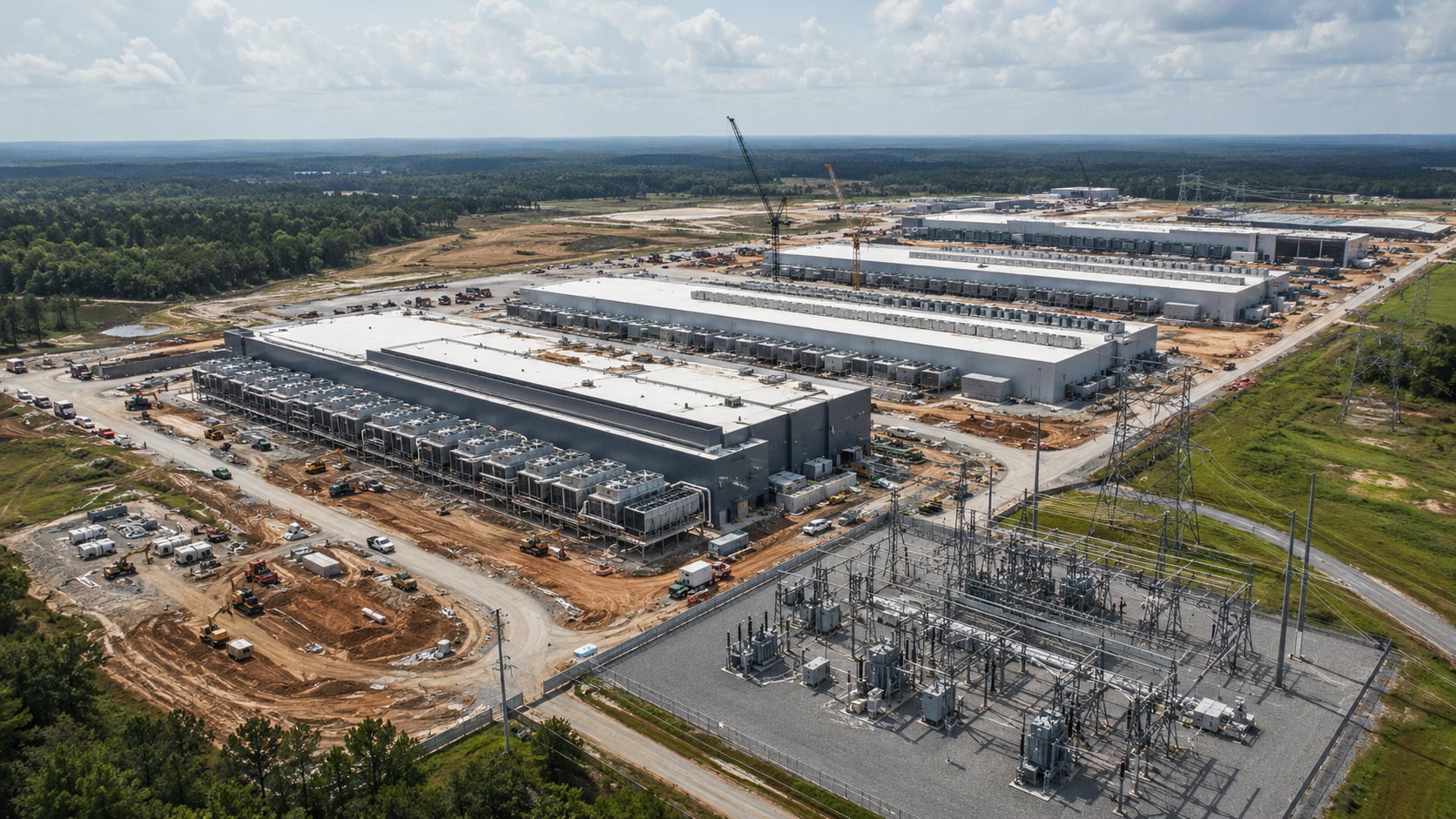
Artificial intelligence may feel like software, but behind every chatbot, image generator and AI assistant is an increasingly physical industry of land, servers, cooling systems and enormous amounts of electricity. Across the United States, that infrastructure is expanding quickly.
For years, data centers were mostly invisible to the average person.
They existed in industrial parks and suburban corridors, quietly handling websites, cloud storage, streaming and corporate computing.
AI has changed the scale of the conversation.
Training and operating advanced AI systems requires enormous computing capacity, and that is pushing technology companies and data-center developers to build much larger facilities across the country. U.S. electricity consumption is expected to reach new records in 2026 and 2027, with AI-related data centers among the major drivers of that growth.
These Are Not Ordinary Server Rooms
Modern AI facilities can contain huge numbers of specialized processors operating continuously.
That creates two immediate requirements:
power and cooling.
The Department of Energy says U.S. data-center electricity use has already risen sharply and could account for roughly 9.5% to 15.3% of total U.S. electricity consumption by the end of the decade under current projections.
The International Energy Agency similarly expects data centers to account for nearly half of U.S. electricity-demand growth through 2030.
That is why data-center development has increasingly become an energy story as much as a technology story.
Why Are They Being Built in So Many Different Places?
The ideal location is not necessarily Silicon Valley.
Developers look for combinations of:
-
large parcels of land
-
access to high-capacity electricity
-
fiber-optic connectivity
-
favorable tax structures
-
available water or alternative cooling options
-
proximity to major population centers or network infrastructure
That has pushed development into places that were never previously thought of as technology hubs.
Virginia remains home to an enormous concentration of data centers, but projects are spreading rapidly into Texas, Pennsylvania, Ohio, Arizona, Georgia and other states.
Some developers are even looking for ways to bring their own power generation to a project rather than waiting years for new grid connections. A proposed Pennsylvania AI data-center campus announced in August 2026, for example, includes plans for on-site natural-gas generation and could eventually reach one gigawatt of power capacity.
The Electrical Grid Is Becoming Part of the AI Race
The challenge is that a data center can sometimes be built faster than a new power plant or transmission line.
That mismatch is becoming important.
Federal regulators have already moved to accelerate the process of connecting large AI data centers to regional power grids, while requiring developers to bear the cost of certain infrastructure upgrades.
At the same time, grid operators are trying to determine how to serve massive new loads without reducing reliability for everyone else.
PJM Interconnection, which operates the electric grid across a large portion of the Mid-Atlantic and Midwest, recently proposed procedures that could require certain data centers to switch to backup generation during grid emergencies.
That would have sounded like an obscure utility issue only a few years ago.
Today it is part of the infrastructure required to run AI.
Communities Are Starting to Notice
For local governments, a major data center can mean substantial investment and tax revenue.
For residents, the calculation can look different.
Communities considering new projects increasingly ask about electricity prices, water consumption, noise, land use, tax incentives and how many permanent jobs a facility will actually create.
A Reuters/Ipsos poll conducted in 2026 found broad concern about the pace of AI-data-center construction, particularly over electricity costs and resource use.
That tension is likely to become more visible as facilities move beyond established data-center markets and into new communities.
AI Has a Physical Footprint After All
The popular image of AI is almost entirely digital.
A prompt goes into a screen. An answer appears seconds later.
What users do not see is the infrastructure behind that interaction: processors, substations, cooling equipment, backup generators, transmission lines and increasingly enormous buildings.
That may become one of the defining technology stories of the next several years.
The race to build better artificial intelligence is also becoming a race to build the physical systems capable of running it.
And increasingly, those systems are being built somewhere in America.